

MODEL RAILWAY Guided Tour
What to Look For:
An amazing amount of detail has been put into this marvellous model railway built entirely by volunteers! Navigate your way around it with the guide below.
Can You Find:
44 people?
6 dogs and livestock?
14 wild animals?
1. Front, Centre
The community of Albert Canyon was an important location on the railway for many years. Until 1936, Albert Canyon was a location where pusher locomotives were added to trains to assist in the climb to Rogers Pass. After 1936 its importance was diminished with the arrival of more powerful steam locomotives.
Our Albert Canyon display represents the 1920s and includes the engine house, water tank, sand tower and oil tank for locomotive fuel. Revelstoke steam locomotives were oil fired from 1912 to the end of steam operations in 1956.
Albert Canyon had a school for the children of the railway employees. Look for the station master’s children at the station who are heading to school. They had to cross the tracks when it was safe, to get to school.
Also, try to spot “The Thinker” sitting on a stump, and various railway employees going about their routines. Look inside the small white building which was a pump house with a boiler for heating the locomotive fuel oil.

2. To Your Left or Westbound
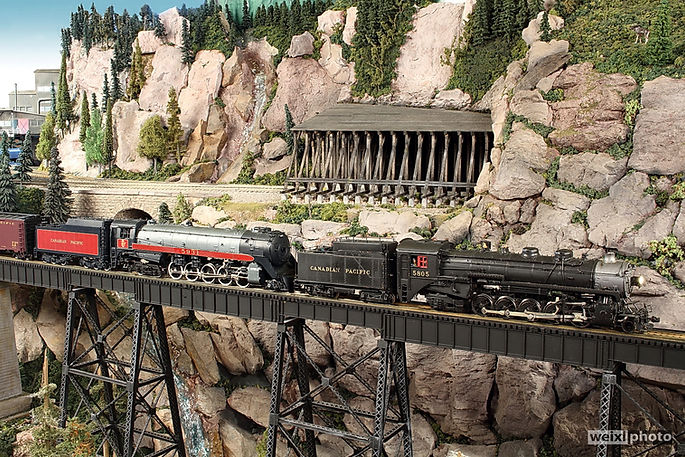
Twin Butte bridge was the longest and highest bridge on the railway between Rogers Pass and Revelstoke. It was originally constructed of wood but was rebuilt as a steel trestle in 1906 and rebuilt again in the 1980s to a double track concrete deck steel bridge.
Our model depicts the second bridge as it looked in the 1950s.
At the base of the bridge, look for the deer, and the Hobo* campfire. Also, behind the bridge is a typical CPR snow shed and a masonry bridge over Twin Butte creek.
See if you can spot the Mountain Goats, the Moose and the Grizzly bear.
*during the Depression in the 1930s, thousands of people rode the rails illegally, in search of work. They were referred to as "hobos"—the origin of the term is uncertain.
3. Further to Your Left
Here we see the hydro-electric dam on the Illecillewaet River. Revelstoke has a hydro-electric history that goes back to the 1890s. The powerhouse for the dam was further downstream and is not modelled. The stiff leg crane and clamshell bucket were used to remove debris.
On the upper track you can see the fictitious Unlikely & Improbable Coal Company, Notch Hill Mine. Notice the two workers, Dolittle and Sitmore, discussing politics.


4. To Your Right or Eastbound
During the early years of operation between Rogers Pass and Revelstoke, passenger trains would often stop to allow passengers to step off of the train and view the breathtaking gorge of the Illecillewaet River that was known as Albert Canyon. The town of Albert Canyon derived its name from Albert Canyon which was named for the nephew of Major Rogers who discovered Rogers Pass.
Look for the photographer at the observation platform.
Flat Creek bridge is next. It flows into the Illecillewaet River.
5. Further to Your Right
Glacier station was built in 1915 during the construction of the Connaught Tunnel. The creek behind the station is the start of the Illecillewaet River. Look for the hikers.
The two tracks turning into the wood tunnel portal form a wye which was used for turning helper locomotives, rotary snow plows and wedge plows.
The creek flowing under the wye tracks is Rogers Pass creek. Look for the moose hiding in the trees.


6. Even Further to Your Right
The Connaught Tunnel is five miles long and eliminated several miles of a troublesome right-of-way through Rogers Pass. It was completed in 1916 and was converted to single track in 1958. The round devices on the deck are squirrel cage fans which were powered by large diesel engines. In the 1970s, the fan house suffered two serious fires and was rebuilt with more modern diesels but the fans are the same. They can move 700,000 cubic feet of air per minute to blow locomotive exhaust out the east portal of the tunnel.